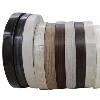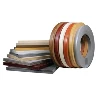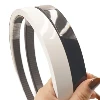

The edge sealing process of the cabinet has many methods and forms, and different process forms, the edge sealing effect, durability, and beauty are also different. The most common are these main process forms:
1) EVA edge sealing
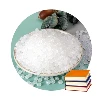
EVA edge sealing is also known as hot melt adhesive edge sealing, that is, the solid granular hot melt adhesive in the following figure, melting treatment at high temperature, and after a professional edge sealing machine to melt the hot melt adhesive evenly coated on the profile of the plate, and then extrusion bonding edge strip, you can complete the edge sealing treatment, this is EVA edge sealing.
Several characteristics of EVA edge sealing
EVA edge sealing process in the production, need to use a lot of glue, so it is easy to produce glue overflow situation, such as now on the market will see some lighter color of the plate, the edge will have a layer of obvious glue line, but the darker color is not visible. Another point is that EVA edge is more sensitive to temperature, it is easy to be affected, higher temperatures will lead to the problem of overflow and cracking.
2) PUR edge sealing
PolyUrethane edge, its full name in English is PolyUrethane Reactive, which is named after the PUR liquid glue it uses. The full name of PUR glue is more complex, moisture-curing reactive polyurethane thermal sol, of course, it is good to know about it. The PUR process and EVA edge sealing are almost no different. All need to be heated at high temperature, the glue is applied to the cutting surface, and the final edge sealing strip is extruded and bonded.
After high temperature heating, PUR glue can produce a chemical reaction with the humid gas in the air, thereby absorbing a large amount of H2O in the air, that is, water, so that it produces a cured state. Therefore, the big difference between it and EVA edge sealing is that the amount of glue will be much smaller, and this edge sealing method is not sensitive to temperature at all, and the impact of temperature is almost minimal.
Durability, environmental performance, edge bonding performance is much stronger than EVA edge sealing. On the other hand, PUR edge, whether it is a light-colored sheet or a dark sheet, will not produce obvious glue lines, and the beauty is far more than the EVA edge sealing process. However, this kind of edge sealing method because of the high cost, so the price will be relatively high.
3) Laser edge sealing
Laser edge sealing, as the name suggests, is the use of laser method to complete the effect of edge sealing. In this process, there is no need to use glue, so there will be no overflow problem, the laser light-sensitive coating on the cutting surface of the plate, and the use of a special laser sideband, after laser rapid high temperature treatment, the cutting surface of the light-sensitive coating and cutting surface, as well as the laser sideband three firmly welded together. And the bonding strength is enormous.
Laser edge sealing process does not use glue, environmental performance is the best, in addition, his flatness, durability are much stronger than the first two, there is a certain waterproof effect.
4) Hand edge sealing
Manual edge sealing, as the name suggests, is purely to rely on the woodworker on-site manual edge processing. If the cabinet is looking for a carpenter, it is usually manually sealed.
The first three forms of process are the three most commonly used ways of using machine edge sealing for whole-house customization, while manual edge sealing relies on both hands to seal the edge. Hand-sealed edge, relatively not environmentally friendly, more defects.