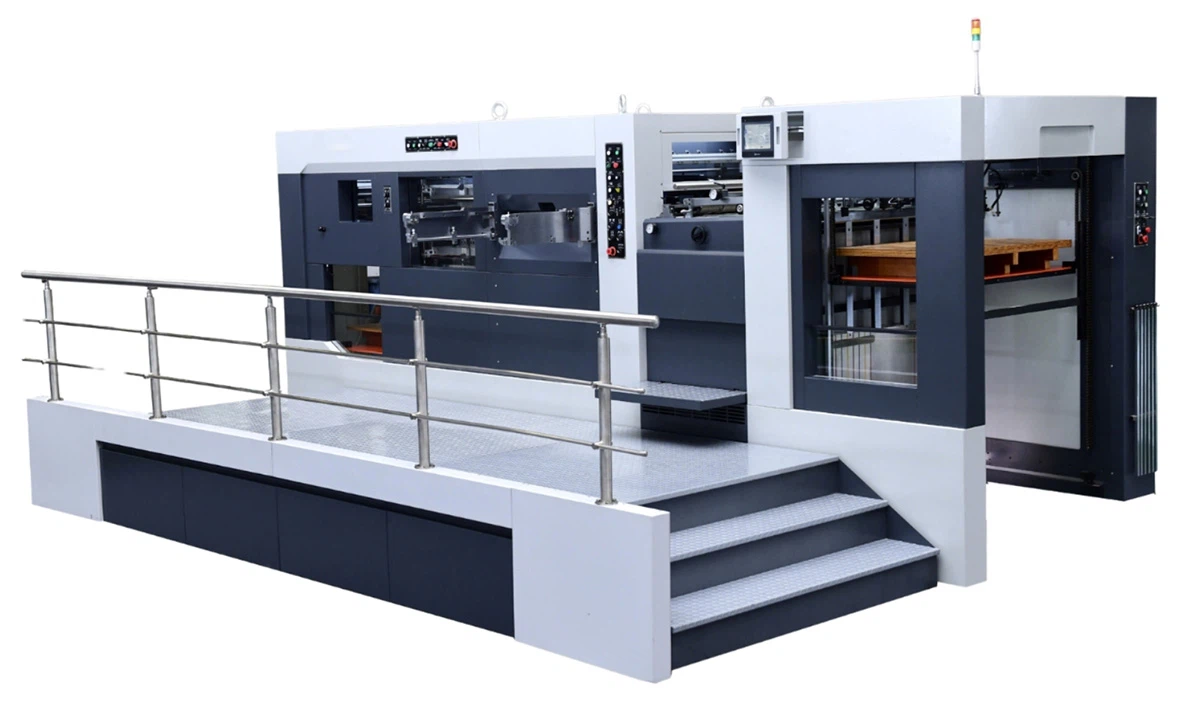

Inaccurate Crease Position on Automatic Paper Die Cutting Machine
Causes: Misalignment between the position and the printed product; misalignment between the die-cutting machine and the printing slot; irregular gripper edge on the cardboard; inconsistent feeding position during machine operation; deformation or stretching of the cardboard, inaccurate printing.
Solutions: Recalibrate the template according to product requirements, align the printing and die-cutting slots; adjust the die-cutting machine's feeding positioning rules to maintain consistent feeding position; reduce the impact of printing and material defects on the quality of the die-cutting machine.
Unclear Crease with Visible Lines and Burst Lines
Causes: Incorrect calculation of the thickness of the paper padding under the steel wire, either too low or too high; inappropriate selection of the steel wire; improper pressure adjustment on the die-cutting machine, either too high or too low; poor quality cardboard, low moisture content leading to increased brittleness and reduced elasticity.
Solutions: Recalculate and adjust the thickness of the paper padding; check if the steel wire selection is appropriate; properly adjust the pressure of the die-cutting machine; adjust the creasing process parameters according to the condition of the creasing cardboard to make them compatible.
Non-Standard Crease Lines
Causes: The creasing groove on the paper padding under the steel wire is too wide, causing the position of the crease to be uncertain; insufficient thickness of the steel wire padding, non-standard groove angle leading to unnecessary arcs, inappropriate tightness of the knife mounting, too tight at the bottom causing instability of the crease; loose steel wire causing the crease to wobble.
Solutions: Replace the steel wire padding paper, making the creasing grooves narrower; increase the thickness of the steel wire padding and reshape the groove angle; adjust the tightness of the knife mounting to be appropriate.
Tooth Marks on the Die-Cutting Surface
Causes: Poor quality of the steel knife, blunt tooth surface, poor die-cutting suitability; severely worn tooth surface not replaced in time; insufficient machine pressure; negligence in adjusting the paper padding under the steel knife during pressure adjustment.
Solutions: Choose steel knives with different quality characteristics according to the properties of the die-cutting cardboard to improve die-cutting suitability; regularly check the wear of the steel knife tooth surface and replace it in time; appropriately increase the die-cutting machine pressure; readjust the steel knife pressure and replace the paper padding.
Cardboard Sticking to the Knife Plate After Die-Cutting
Causes: Insufficient elasticity of the surrounding rubber due to its thinness or inappropriate selection of rubber hardness; blunt tooth surface of the steel knife, too thick cardboard causing knife clamping or excessive pressure during die-cutting.
Solutions: Select different hardness rubbers according to the distribution of the steel knives on the template, ensuring proper distribution when adhering the rubber; appropriately adjust the die-cutting pressure and replace the steel knife if necessary.
Cracks in the Creased Areas During Folding
Causes: If the cardboard cracks on the sides of the crease during folding, it is due to too deep a crease or insufficient crease width; if the cardboard cracks on the inside, it is due to excessive creasing pressure or overly deep creasing.
Solutions: Reduce the thickness of the steel wire padding; widen the crease line according to the thickness of the cardboard; appropriately reduce the pressure of the die-cutting machine; or replace with a slightly lower height steel wire.